How to Choose Professional Manicure & Pedicure Tools for Salon-Quality Results
Published: January 01, 2026
Walk into any well-run nail salon and you'll notice something before you even sit down: the tools. Neatly arranged, gleaming, and clearly well cared for. That's not just for show. In manicure and pedicure work, the instrument does most of the heavy lifting — a good cuticle nipper or pusher can mean the difference between a clean, comfortable service and a client who leaves with nicked skin or a botched cuticle line.
At Beast Instruments, we manufacture manicure and pedicure tools for salons, spas, and individual professionals worldwide, and one question comes up constantly: what actually separates a "professional" tool from the cheap ones sold in drugstore kits? In this guide, we break that down in detail — the materials, the construction, and exactly what to look for before you buy.
Why Tool Quality Matters More Than You Think
A manicure or pedicure tool touches skin, cuticles, and sometimes very close to the nail bed — areas that are sensitive and prone to infection if hygiene isn't maintained. Beyond comfort, there are real safety and business reasons to invest in proper instruments:
- Precision reduces client injury. A dull or poorly aligned nipper can crush skin instead of cutting it cleanly, leading to bleeding, bruising, or hangnails.
- Hygiene compliance. Salon tools need to withstand repeated disinfection — autoclaving, UV sterilization, or barbicide soaking — without corroding.
- Durability affects your bottom line. A cheap nipper that dulls in a month means constant repurchasing. A well-made one can last years with proper care.
- Client experience and retention. Clients notice smoothness, comfort, and how their skin feels after a service — often more than they notice the polish color.
The Core Materials: What Should Your Tools Be Made Of?
Stainless Steel Grade
Professional-grade manicure and pedicure tools are typically made from high-carbon stainless steel, often in the range of German DIN 1.4034 or similar surgical-grade alloys. This type of steel holds an edge far longer than the soft, low-grade steel used in mass-market kits, and it resists rust even under frequent sterilization.
A simple way to check quality: run your nail lightly along the cutting edge of a nipper. A well-made, properly hardened blade will feel crisp and even along its entire length — no soft spots, no unevenness.
Forged vs. Stamped Construction
Just like surgical instruments, quality nippers and pushers are drop-forged rather than stamped from a flat sheet of metal. Forging aligns the internal grain structure of the steel, giving the tool more strength at the pivot point and a cutting edge that holds its sharpness through hundreds of uses. Stamped tools are cheaper to produce but tend to flex, misalign, and dull quickly.
Breaking Down the Essential Tools
Cuticle Nippers
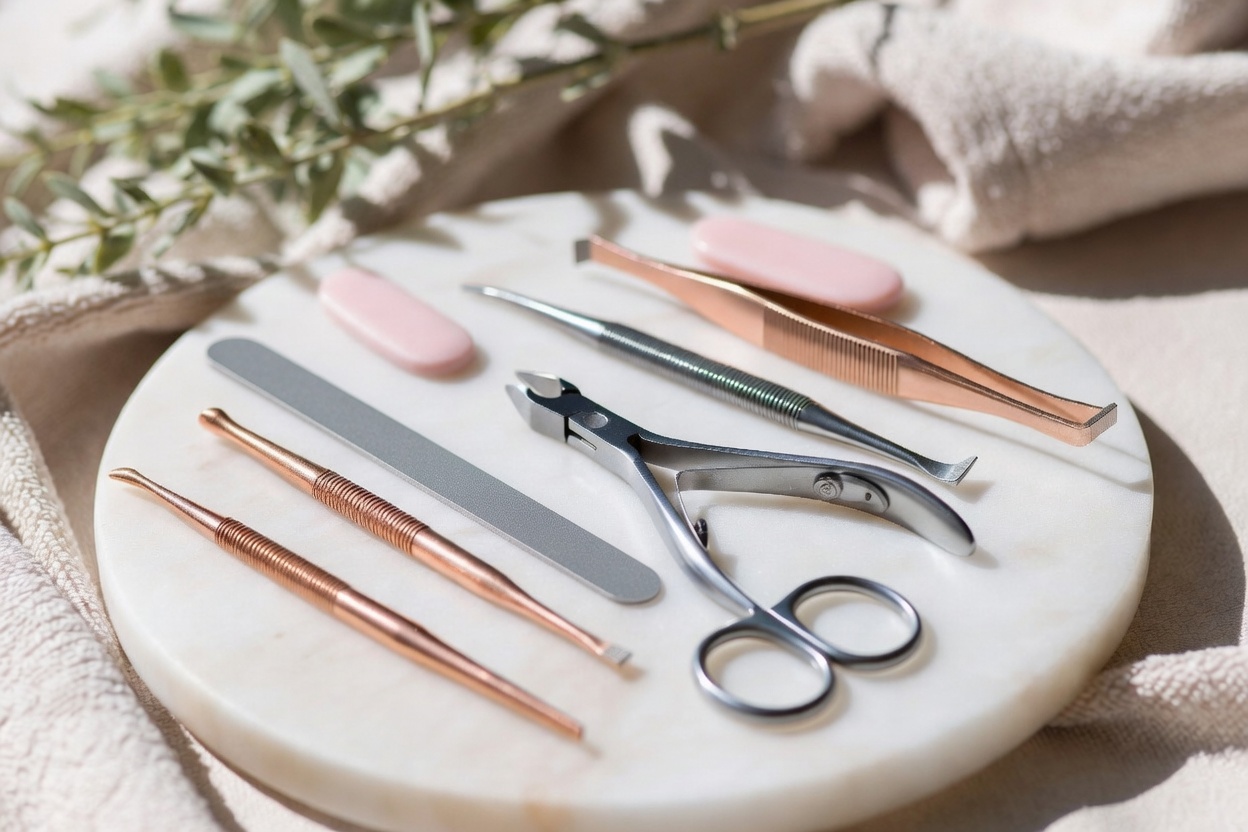
The cuticle nipper is arguably the most important — and most misunderstood — tool in any mani-pedi kit. A good nipper should have:
- A single, continuous cutting edge with no gaps where skin can get pinched.
- A smooth spring action that opens and closes without resistance or looseness.
- A jaw size matched to purpose — smaller jaws (around 4mm) for detailed cuticle work, slightly larger for pedicure use where skin is thicker.
Cuticle Pushers
Pushers come in various shapes — the classic "shovel" end for pushing back cuticles, and pointed ends for cleaning under the free edge of the nail. Quality here shows up in the finish: a well-polished edge won't scratch or damage the nail plate, while a rough or poorly finished edge can cause micro-scratches that lead to ridges over time.
Nail Files and Buffers
While not metal instruments, files and buffers still matter for consistency. Look for tools with a consistent grit rating and a core that doesn't warp or bend excessively during use — inconsistent grit leads to uneven filing and can weaken the nail edge.
Pedicure-Specific Tools
Because pedicure work deals with thicker skin and calluses, tools like foot files, callus removers, and larger nippers need more robust construction. The steel needs to stay sharp against tougher, thicker skin without requiring excessive pressure from the technician — which also reduces hand fatigue during a full day of appointments.
How to Choose the Right Stainless Steel Grade for Your Kit
Not every professional needs the same steel grade. Here's a simple way to think about it:
- High-volume salons: Invest in higher-grade forged steel (DIN 1.4034 or equivalent). The higher upfront cost pays off through durability across hundreds of clients.
- Independent technicians or mobile nail artists: Mid-to-high grade stainless steel tools offer a good balance of cost and longevity, especially if properly maintained between uses.
- Home or personal use: Even for personal kits, avoid the lowest-grade steel — it dulls fast and can rust after just a few sterilizations, which is a hygiene risk even for at-home use.
Maintenance Tips That Extend Tool Life
Even the best instrument won't last if it's not cared for properly:
- Clean immediately after use — don't let organic residue dry on the blades.
- Sterilize according to your region's health guidelines — autoclave, hospital-grade disinfectant soak, or UV sterilization depending on your setup.
- Dry thoroughly before storage — moisture left on stainless steel, even high-grade steel, can eventually lead to spotting.
- Store in a case or roll, not loose in a drawer, to protect cutting edges from nicking against other metal tools.
- Sharpen periodically rather than waiting until the tool is fully dull — a professional sharpening service can extend the life of quality forged tools significantly.
Our Approach at Beast Instruments
Every manicure and pedicure tool we manufacture is forged from certified stainless steel and finished by hand to ensure a clean, even cutting edge and smooth pivot action. We build our tools the same way we build our surgical and dental instruments — with the understanding that these are precision tools used close to skin, day after day, client after client.
Whether you're outfitting a full salon, building a mobile kit, or simply want a professional-grade set for personal use, choosing the right tool isn't about the flashiest handle color — it's about the steel, the forging, and the finishing behind it.
Explore our full range of manicure, pedicure, and beauty instruments — precision-forged for salons and professionals worldwide.